
A Note From the Scaffolding
I do not intend for this platform to become a compilation of essays concerning my time in college. That being said, here is another essay about my time in college.

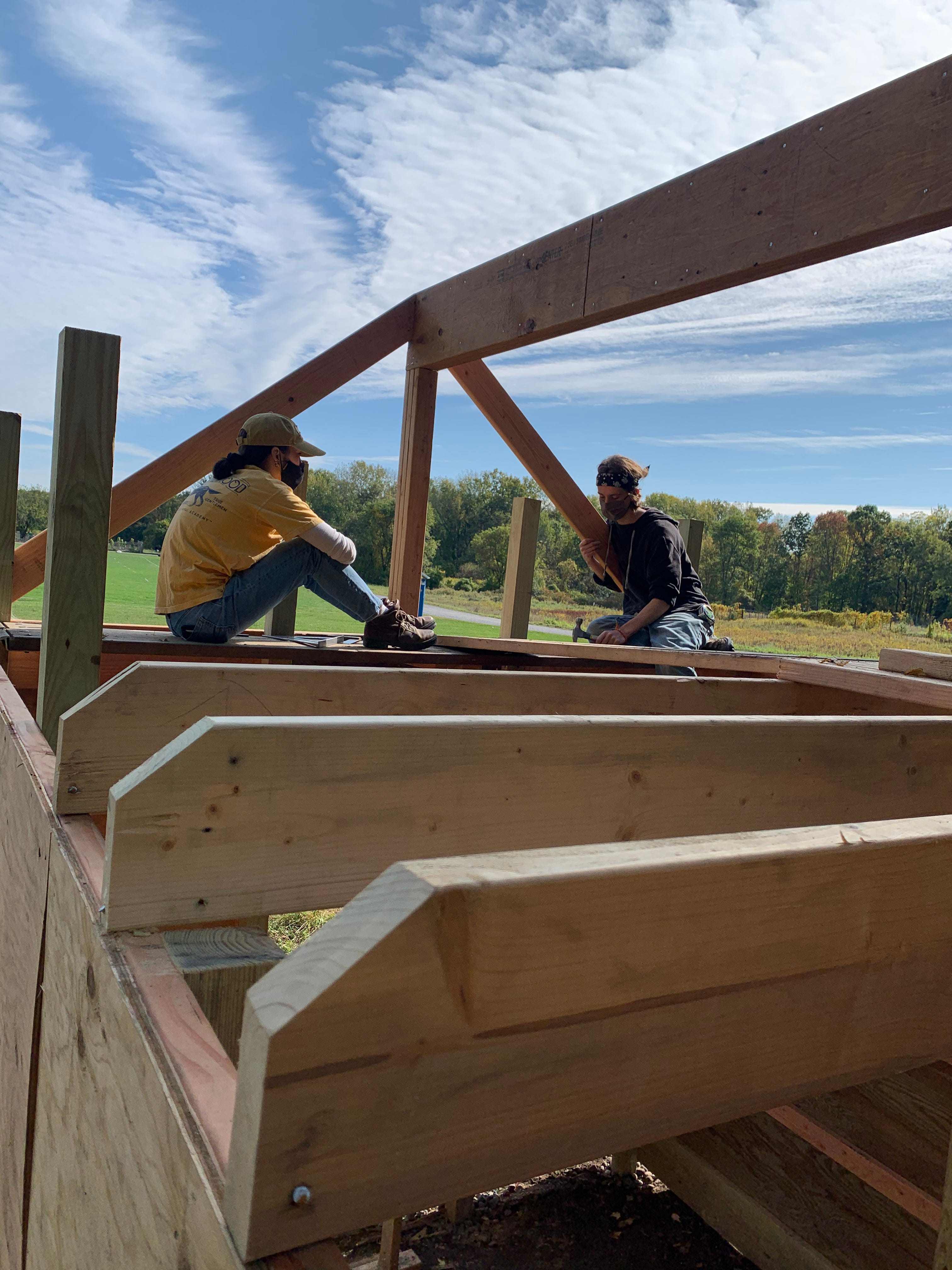
I signed up to build a cabin because I did not want to go to class. The cabin building elective met only on Thursdays from four to six pm. This seemed more desirable than a class that met twice a week, so I cobbled together an essay about why I was invested in nature, collaboration, and constructing an exact replicas of Henry David Thoreau’s cabin. It is my enduring suspicion that I was only selected for the class because the professor needed a relatively even gender split. (Not just boys can build things, girls can operate a hammer, etc etc, etc.)
A few weeks before the semester started, I received an email from my professor informing the class that, after calculation and discussion with an experienced construction worker, we would need to meet for an additional 4-6 hours every single Sunday in order to complete the cabin by the end of the semester. While I had been interested in the class initially because it met infrequently and barely seemed like a class at all, I had grown slightly excited about the process of making something with my own hands. So, despite the extra time commitment, I remained in the class.
I should, at this point, describe my relationship with Henry David Thoreau. Prior to the class, I had never read his work. Throughout the course of the semester, we would be required to read both Walden and an extensive biography which included various letters and poems Thoreau had penned at one point or another. Having now read both of these books and sat with them for a few years, I can confidently say that I don’t particularly like Thoreau’s writing. I do not deny his strength as an author or the importance of his words. But when reading Walden, I felt as though I was wading through very deep mud just to reach whatever sentences lingered softly in my mind.
As the class progressed and I made my way through both books, I began sticking post-it notes to my wall with excerpts from Walden and Thoreau’s letters and poems. I was, in short, trying very very hard to like his writing. And some of his words I did love, deeply and without reservations. Here are some of my favorites, which made it onto my wall:
Every child begins the world again.
We must learn to reawaken and keep ourselves awake, not by mechanical aids, but by an infinite expectation of the dawn, which does not forsake us even in our soundest sleep.
I might have loved him had I loved him less.
Beauty is where it is perceived. When I see the sun shinning on the woods across the pond, I think this side the richer which sees it.
The hawk is the aerial brother of the wave.
There is no remedy for love but to love more.
I could go on, but these are the specific few that I often return to. And through these lines and their placement amongst a host of other sentences that did not resonate with me, I made one of the most important realizations of my life:
You’re allowed to like only parts of things, even if the rest doesn’t suit you.
This might sound obvious, but it never was to me. Prior to reading Thoreau, I thought I had to either appreciate something in its entirety or despise it in its totality. There was no sliding scale, no way to like something halfway. But once I realized that it was possible to like parts of a book and not the entire thing, lots of other things started to make sense. Suddenly, you could love someone more than you loved someone else, with the knowledge that it was still love, in either case. You could need a person sometimes but not always. You could want something and then stop wanting it and then start wanting it again. There was more freedom to feel than I had ever imagined.
Had I not made this realization, I would have considered the actual construction of the cabin completely abhorrent. With this newfound knowledge of grey areas in my back pocket, I found the building process to be sometimes intolerable, sometimes tolerable, sometimes enjoyable, and sometimes, actually, really beautiful. There was a lot of manual grunt work involved, the correct terminology of which I am unsure of. We weeded and leveled land, dug post holes, filled them with gravel, attached the sides (?) of the building to the poles (?), constructed scaffolding, raised rafters, inserted a ridge beam, and nailed shingle after shingle after shingle.
The most beautiful part of the entire process was how I began to measure time. On Thursdays, as daylight savings kicked in, the fading light threw down long shadows of trees onto the field in which we were constructing the cabin. After a few weeks, I could guess the time based entirely off of how far these shadows stretched across the field. I knew it was 5pm when the tips of the tree branch shadows bled out just beyond the edges of the grass and into the forrest, shivering alongside me in the wind. When it got dark we worked with headlamps.
I also became good friends with another student in the class. Perhaps “good friends” is an overstatement, as I never learned his last name and we are not in contact whatsoever. He was quiet, like me, and I liked watching him draw in the dirt with sticks he salvaged from the forest. Once we started spending time together, our productivity declined drastically, but nobody seemed to care and neither did we. He showed me photographs he took and we played a game where we tried to see how little work we could get away with doing (though I actually may have been playing this game by myself). I recall one unusually warm day when the two of us sat together on the rafters and didn’t talk and didn’t need to. We thought our separate thoughts and I return to this moment often. I hope that, wherever he is, he is happy, and warm, and still wears the bandana that always hung around his neck.
Sunday mornings were the hardest. Most of the time, I stumbled to the building site wildly hungover, dehydrated, and running on 6 tablets of Advil for ailments I did not actually have. Sundays were long and cold and lonely. There was always somewhere else I wanted to be. Working in the library with friends, or eating shitty muffins in the dining hall, or sitting by the pond looking at the wildflowers that refused to die, or lying in bed in my dorm room listening to my suite mate practice Mandarin through our shared wall. On Sundays, I was painfully aware how seamlessly the rest of my world could operate without me.
I never took a picture of the completed cabin, a fact which you could project a number of reasonable assumptions on to. Nobody respected the integrity of our work either, so the building was simply used as a shed to store gardening equipment for the next two years. Also, I think people fucked in it. I still wonder what the “point” of the class was, whether I learned anything through the manual labor, whether I am a different or better person as a result of bruising my thumb nails blue for four months. My spot in the class certainly could have gone to someone more talented, dedicated, and resourceful. I can still barely use a hammer. I do not remember the technical names for many of the things we did. Often, I hated being in class.
Many people are aware of the fact that Thoreau did not, in fact, live completely alone in the woods by Walden Pond. He left the woods at times, he hosted visitors, and he is rumored to have done his laundry at his mothers house. The point, my professor explained after a student brought this up, was not that Thoreau truly lived a completely self-sufficient lifestyle. He never pretended to. What mattered was that, at the core of the experience, was the desire to simplify and turn inwards in an unprecedented way.
In that sense, then, the class was meaningful. Building, at least for me, gave me time to think. Many of my classmates described going into a kind of trance as they pounded nails, some sort of enjoyable semi-conscious state that was devoid of thought and emotion. As I was terrible at pounding nails, I never achieved this feeling. Instead, I had time to sit with my own thoughts. Pounding nail one: Why am I so bad at this? Pounding nail two: Are people noticing? Pounding nail three: Do I even care? Pounding nail four: Where would I rather be? Pounding nail five: Sitting on the top of a mountain. Pounding nail six: What kind of mountain? Pounding nail seven: A tall, green one. Pounding nail eight: What would I be thinking about? Pounding nail nine: About building a cabin.
What I mean to say is that my thoughts, no matter how layered or abstract, always circled back to what I was doing in the moment. If I had a hammer in my hands, eventually I’d remember that I had a hammer in my hands. Construction, and my inability to do it efficiently, forced me into being present in ways I had never been before.
Can I still daydream freely? Yes, of course. Daydreaming is a necessary part of being alive and I am grateful for my ability to take myself places where I cannot actually go. But my daydreams now are underscored by desires I can name. As I daydream, I return to my current surroundings frequently enough that I don’t lose sight of where I actually am or what I actually want. I understand that the strange wanderings of my mind are rooted in fundamental desires. Desires for purpose, strength, confidence, intelligence, and acceptance.
I still think about the cabin often. About sunsets and hawks and remedies for love.